

✓ Verified February 2026: I performed a blind taste test with standard unbleached filters. Rinsing with hot water continues to be the best way to remove the cardboard-like flavor note before brewing. (See how I test)
- Jeffrey, Your Dream Coffee
The question of rinsing paper coffee filters is not a matter of debate among professionals; it is a standard operating procedure required for consistent extraction and flavor clarity.
Skipping this step introduces foreign flavors (often described as "cardboard" or "papery") and negatively impacts the thermal stability of the brewing vessel.
Quick Answer: Should you rinse paper coffee filters?
Yes. You must rinse paper filters with hot water before adding grounds. This process accomplishes three critical tasks: it removes residual paper fibers and factory odors, preheats the brewing vessel to prevent thermal loss, and ensures the filter adheres to the brewer walls for uniform water flow.
While the summary above covers the primary benefits, failing to rinse brown (unbleached) filters specifically can impart a distinct woody taint that overpowers delicate roast profiles.
The following analysis outlines the mechanical and chemical reasons for adopting this pre-wetting protocol.

Core Benefits of Rinsing Filters
Paper filters are absorbent matrices of cellulose fibers. When dry, these fibers are loose and can impart soluble organic compounds into the brew.
1. Removal of Papery Taint
The primary objective of rinsing is to improve sensory quality.
Dry paper contains lignin and manufacturing residues that release a "cardboard" or "woody" flavor upon contact with hot water. This is particularly noticeable in unbleached (natural) filters.
The Fix: flushing the filter with 100-200ml of hot water dissolves these surface compounds, flushing them into the sink rather than your cup.

2. Thermal Stability (Preheating)
Brewing into a cold vessel (like a Chemex or ceramic V60) instantly saps heat from the slurry, lowering the extraction temperature.
The Mechanism: Rinsing with off-the-boil water acts as a pre-heating cycle. It raises the surface temperature of the brewer and the carafe (server).
This ensures that when brewing begins, the water temperature remains stable within the ideal extraction range (195°F-205°F / 90°C-96°C), rather than losing energy to the cold equipment.
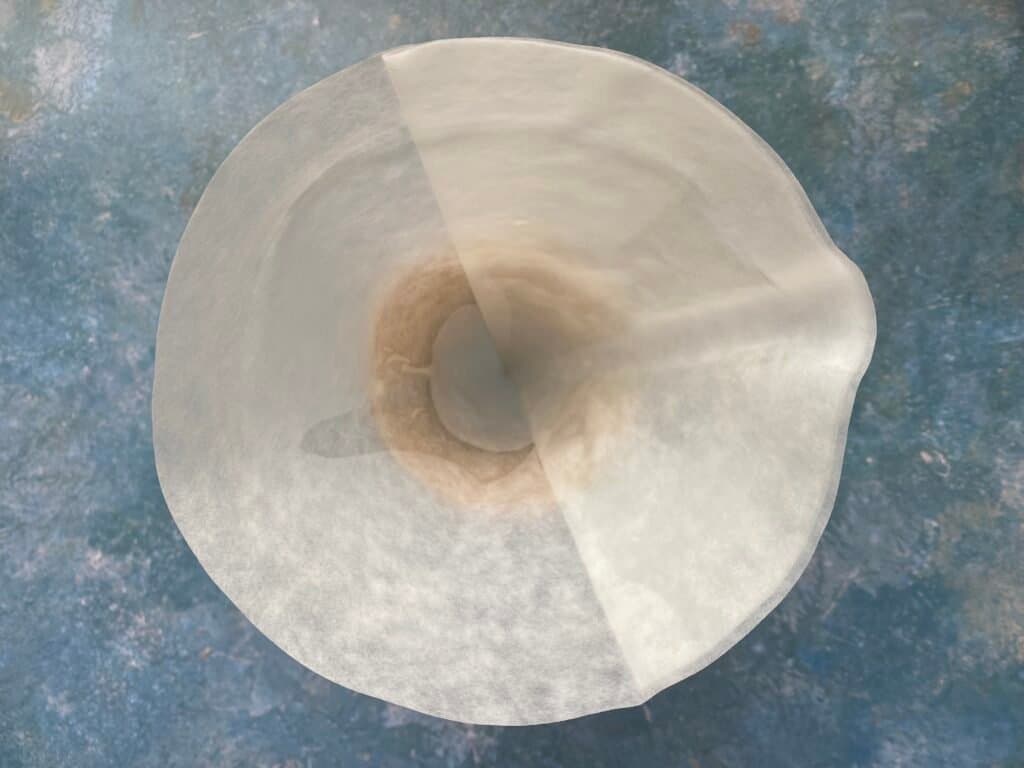
3. Optimized Hydraulic Seal
A dry filter has structural rigidity that often leaves gaps between the paper and the brewer walls.
The Result: These gaps can allow water to bypass the coffee bed (channeling), causing it to flow down the side of the brewer instead of through the grounds.
Wetted filters become pliable and adhere tightly to the brewer's geometry (especially the ridges of a Hario V60). This forces the water to travel through the coffee bed, increasing extraction efficiency and consistency.

Protocol by Device
While the principle remains the same, the application varies slightly by device:
- Pour-Over (V60/Kalita). Essential. Rinse thoroughly to seat the filter in the ridges. Discard water from the server before brewing.
- Chemex. Critical. The Chemex filter is 20-30% thicker than standard filters, allowing more potential paper taste to be retained. Use a larger volume of water (200ml+) to fully saturate the triple-fold section.
- AeroPress. Optional but recommended. While the surface area is small, rinsing ensures the filter stays in place on the cap and prevents leakage during the inversion method.

The "Blind Taste" Experiment
If you are skeptical about the flavor impact, you can perform a simple diagnostic test at home (commonly used in barista training).
- Prepare two cups. Place a rinsed filter over Cup A and a dry filter over Cup B.
- Pour hot water. Pour 100ml of hot water through each filter.
- Wait and Taste. Let the water cool slightly. Taste the water from Cup A (Rinsed). It should taste neutral.
- Taste Cup B. Taste the water from Cup B (Dry). You will likely detect a distinct astringency or woody note. This is the flavor you are currently adding to your coffee.
Conclusion
Rinsing the filter is a low-effort, high-impact variable in coffee brewing. It eliminates foreign flavors and stabilizes the thermal environment of the extraction.
By integrating this step into your workflow, you ensure that the only flavors in your cup come from the beans, not the manufacturing process.
Have you tried the water taste test?
Share your results in the comments below. Did you notice the "cardboard" flavor?





12 Comments
Rinsing your paper filter makes so much difference in the taste of your coffee. Thank you for sharing that with others!
Hey Deidre,
Rinsing your paper coffee filters indeed makes a big difference in taste; I’m glad you liked the article!
-Jeffrey
Many people will not get, or take the time to experience, the difference of rinsing their coffee filter. That's ok, their just drinking coffee to wake up, not really for the enjoyment of the best flavors possible of a finer cup of coffee. The same people will not weigh their coffee, or the water, for the best recipe possible in their cup.
Just my humble opinion. Thank you Jeffrey, for the article to remind us, how to make better tasting and more flavorful coffee. Cheers ☕️
Hey Ron,
I’m glad you liked the article. Keep drinking amazing coffee!
-Jeffrey
I wouldn’t waste the water. I tried both, it’ made no difference. After it rains I use bottled water to avoid the chemicals they use to treat the runoff entering the water system. It smells like a swimming pool coming out of the tap.
Hey Rebecca,
It’s up to you if you prefer rinsing the paper coffee filters. If I were in your position, I’d also use bottled water wherever possible.
-Jeffrey
It’s really easy to tell how an unrinsed filter will affect coffee taste. Just pour several ounces of hot water through a paper filter alone, into a cup, aand taste the water in the cup! That’s the paper flavor that is being added to your coffee without rinsing first.
Hey UbdU,
That’s a great way to taste the difference in rinsing your coffee beforehand. Thanks for sharing!
-Jeffrey
Does this apply to pour over coffee only? Or regular 12 cup coffee makers as well?
Hey Heather,
You can rinse all paper filters before use; however, I don’t rinse all of them, just like the AeroPress filters I’ve mentioned in the article.
It’s possible to rinse the coffee filter of a 12 cup coffee maker. You can rinse it before adding it to the machine or pour off-the-boil water onto the filter once it’s fitted in the coffee maker.
I hope this helps you!
-Jeffrey
Hi Jeffrey,
Since I have been rinsing the paper filters when I brew my coffee in a four cup coffee drip coffee pot, I have noticed a big difference in the taste.
Thanks so much for the info
Hey Dana,
That’s so great to hear! I hope you keep enjoying your coffee 😊
– Jeffrey