

Many coffee lovers describe Starbucks as burnt, smoky, or bitter. If you've wondered why, you're not imagining things; the flavor profile is by design.
Quick Answer: Why does Starbucks coffee taste burnt?
Starbucks roasts darker than most specialty roasters. Dark roasting pushes beans through more caramelization, creating bold, smoky flavors with lower acidity and a heavier body. That profile is consistent worldwide and cuts through milk and syrups, but it can be perceived as "burnt" or bitter.
In this article, it's time to unpack what you're tasting, how Starbucks roasts and brews at scale, and the simple order tweaks that make your cup smoother.
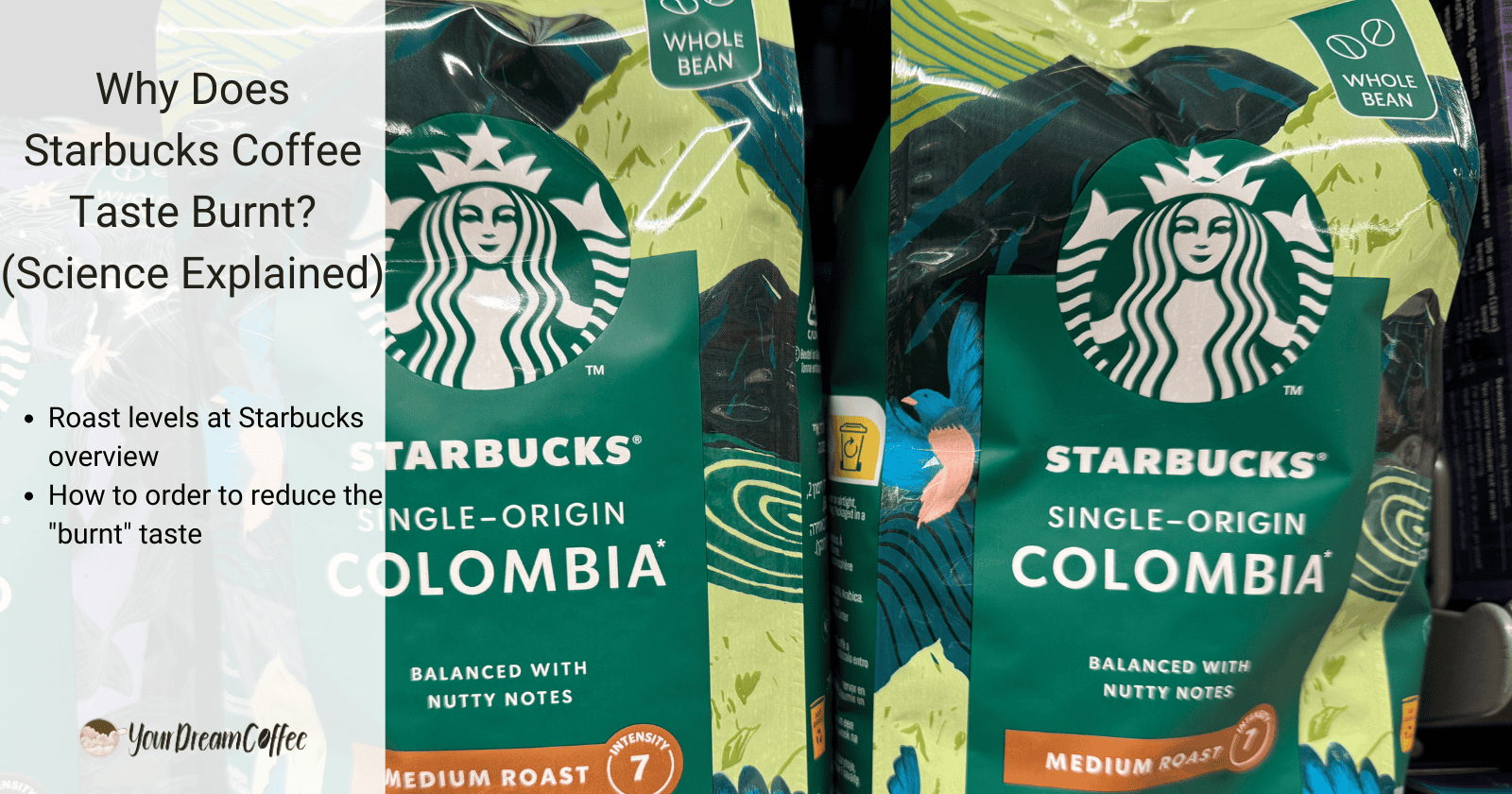
Why does Starbucks coffee taste burnt?
When someone says "Starbucks tastes burnt," they're usually noticing a cluster of flavors rather than literal scorched beans.
Dark roasting coffee beans reduces acidity and intensifies flavors, pushing them toward smoke, char, and bittersweet cocoa notes.
That can be pleasant if you like a heavy, robust cup, but it reads as ashy or bitter if you prefer brighter, fruit-forward coffees.
A second factor is extraction; even with the same beans, brewing too fine, too hot, or too long pulls more bitter compounds.
When you taste that coffee, it'll linger as a subtle bite, with sweetness that feels flatter than in lighter roasts.
Add surface oils (common in darker roasts) and you get a heavier mouthfeel that some interpret as "burnt".
Starbucks' roasting philosophy explained
Starbucks built a global brand on a flavor you can recognize anywhere.
Darker roasting helps them achieve that: it smooths out variability between lots and harvests, and it creates a base that stands up to milk, syrups, and ice without tasting thin.
That signature boldness is part preference (many customers like it) and part practicality (it's reliable across thousands of stores).
It's also why Starbucks offers a spectrum of different roasts like blonde, medium (like Pike Place), and dark, but the "house" identity still leans robust.
If your palate is tuned to lighter roasts from specialty cafés, Starbucks' darker profile can feel smoky by comparison.

Tip: Check out the best Starbucks coffee beans here!
How does coffee roasting work?
As green coffee heats, a few big milestones define flavor:
- Maillard reactions (around 140-170°C): sugars and amino acids create brown-roast flavors and color
- Caramelization (160-200°C): sugar breakdown yields caramel/toffee notes
- First crack (195-205°C): beans audibly pop as internal pressure releases; most light/medium roasts end not far after this
- Second crack (220-230°C): deeper roasting fractures the structure; oils migrate outward; smoky compounds rise
The closer a roast gets to or passes the second crack, the more you taste flavors such as smoke, char, and bittersweet chocolate.

You won't be able to taste the origin-driven brightness and flavors that make each coffee bean unique. Starbucks commonly targets the darker side of this spectrum.
Roast levels at Starbucks overview
Below, I've made a quick overview of each roast level that Starbucks offers.
Each step darker generally means lower acidity, heavier body, and more roast character. If "burnt" isn't your thing, start with blonde roast:
| Roast level: | Taste: | Acidity: | Body: | Best for: |
| Blonde (light-medium) | Honey, cereal, gentle citrus; less roast | Higher | Lighter | Black coffee, flat white |
| Medium (e.g., Pike Place) | Cocoa, nutty, balanced roast | Medium | Medium | Daily drip, lattes |
| Dark | Smoky, bittersweet, char, roasty finish | Lower | Heavier | Mochas, flavored drinks, with milk |
If Starbucks coffee tastes burnt to you, blonde (in drip or espresso) usually restores sweetness and a gentler finish without losing caffeine or body entirely.

Brewing at the store: why your cup can taste harsher
The way coffee is roasted isn't the whole story. Brewing at scale like Starbucks does introduces variables that can tilt the cup darker:
- Batch brew hold times: If drip coffee sits too long on a warming plate or in a dispenser, it can taste stale or harsher. (Most stores rotate frequently, but timing matters.)
- Espresso extraction: Super-automatic machines must balance grind, dose, water temp, and shot time. Over-extraction (too fine or too long) elevates bitterness
- Water temperature: Hotter water generally extracts more bitter compounds
- Milk steaming: Extra-hot milk flattens sweetness; properly steamed milk tastes sweeter and softens bitterness
Drinks that taste less "burnt" at Starbucks
If you prefer a smoother, sweeter cup, then you don't have to abandon Starbucks altogether. You can try these instead:
- Blonde espresso drinks: Lattes, cappuccinos, and flat whites gain sweetness and cereal notes with a blonde roast
- Cold brew/nitro cold brew: Long, cool extraction emphasizes chocolatey smoothness and trims harsh edges
- Americano with extra water (or light ice): You keep the espresso character while lowering concentration and bite
- Pour over coffee when available: A freshly brewed blonde or a lighter seasonal option often shows more nuance than a standing batch
All of the above-listed coffees won't have that burnt taste to them simply because of changing the roast, the extraction, or the concentration of your coffee.

How to order to reduce the "burnt" taste
To make it easy to order at your local Starbucks, you can use these simple order tweaks:
- Ask for blonde espresso in espresso-based drinks
- Try a ristretto shot (shorter extraction, sweeter profile)
- Add a little extra water to Americanos to soften the intensity
- Request "not extra hot" milk for better natural sweetness
- Choose cold brew over hot brewed coffee if roast flavors dominate for you
- If you want drip coffee, ask for a fresh brew or a pour over when possible

If you still find the coffee you ordered too strong, you can always have syrup added to it. Check out the various Starbucks syrup flavors here.
Brewing Starbucks beans at home without the "burnt" bite
If you have darker-roasted Starbucks coffee beans at home, you can tune your coffee with these steps:
- Grind slightly coarser than you think to avoid over-extraction
- Lower your brew temperature to 92-94°C instead of boiling
- Start with a 1:16 ratio (1 g of coffee to 16 g of water) and adjust to taste
- Shorten contact time for immersion methods (e.g., 3:30-4:00 for pour over, 12-14 hours for cold brew)
- Try Starbucks blonde or medium roasts if dark tastes too smoky

These tips will help you brew the best coffee at home!
Is Starbucks coffee "burnt" on purpose?
Starbucks coffee isn't literally burnt, but it is intentionally roasted darker than many specialty roasters.
This decision is strategic: it creates a bold, dependable flavor profile that holds up well in milk-heavy drinks and flavored beverages, ensuring consistency across thousands of stores worldwide.

Starbucks has built much of its brand identity on that strong, roasty taste.
If you prefer bright acidity and fruity complexity, the darker profile can feel smoky, ashy, or bitter.
In that case, selecting blonde espresso or lighter seasonal options is a better match for your palate.
FAQ's about Starbucks coffee beans
Is Starbucks coffee lower quality and roasted dark to hide it?
Starbucks primarily uses Arabica beans. The darker roast is a consistency choice, not simply a cover-up for quality.
Why do the beans look oily?
At darker roasts, oils migrate to the surface after the second crack. That sheen is normal for dark roasts and correlates with smokier flavors.
Does blonde roast have less caffeine?
Roast level affects density more than total caffeine. By brewed cup or by shot recipe, the caffeine difference is usually small. You can check out this article to learn more!
Which Starbucks drinks are least bitter?
Cold brew, nitro cold brew, lattes, and flat whites made with blonde espresso, and iced Americanos with extra water generally taste smoother.
Conclusion
If you're wondering why Starbucks coffee tastes burnt, the answer lies in roast and extraction: Starbucks intentionally leans towards darker roasts, and brewing at scale can accentuate those roasty, smoky notes.
If that isn't your preference, choose a blonde option, adjust the extraction (try ristretto, add more water, or use cooler milk), or brew at home with gentler settings.
You'll retain the convenience while losing the harshness.


